AI Business Plan Generators: What They Actually Produce (and What Investors Still Reject)
We tested 5 AI business plan generators on the same brief. Honest scores, what investors flag as AI-slop, and the manual edit pass.
TL;DR. We ran the same fictional brief — a B2B SaaS for accountants — through 5 AI business plan generators. All produced something usable. None produced something investors would fund without significant editing. AI now reliably handles the scaffolding (structure, formatting, industry context). The defensible work (financial model, competitive specificity, customer insight) is still on you.
Most reviews of AI business plan generators are scored on the wrong axis. They evaluate the polish of the output — does it look like a business plan? — when the right question is whether the output survives the kind of scrutiny that actually decides funding.
This is a methodology piece. We're SoGood, an AI co-founder platform that produces a business plan as one part of a wider workflow. We tested ourselves on the same rubric as everyone else and reported results without thumb on the scale.
The test brief
"Ledgerly is a B2B SaaS providing AI-powered transaction categorization and month-end close for accounting firms with 5–50 staff. Pricing: $89/firm/month plus $12 per active client. Founders: two ex-Big-Four senior managers. Pre-revenue. We need a plan suitable for a $750k seed raise."
Brief deliberately includes details a tool can use (pricing, ICP, founders) and excludes details a tool would have to invent (TAM, growth rates, CAC, churn). Where a tool invented numbers, we evaluated whether they were sourced, plausible, or hallucinated.
The scoring rubric
Six dimensions, scored 1–5:
- Structure & completeness — does it cover the standard sections?
- Market sizing rigor — TAM/SAM/SOM with sources, or "$X billion industry" hand-wave?
- Competitive specificity — real competitors with real positioning, or generic placeholders?
- Financial model depth — driver-based, or top-down "we'll grow 200% YoY"?
- Hallucinations — invented stats, fake citations. Inverse score: 5 = none, 1 = pervasive.
- Investor-readiness — would this survive 30 minutes with a competent seed investor?
Maximum: 30. Investor-readiness is the score that matters most.
Results
| Tool | Structure | Market | Competitive | Financials | Hallucinations (5=none) | Investor-ready | Total |
|---|---|---|---|---|---|---|---|
| LivePlan | 5 | 3 | 2 | 4 | 4 | 3 | 21 |
| Upmetrics | 4 | 3 | 2 | 4 | 3 | 3 | 19 |
| ChatGPT-4 (structured prompt) | 4 | 2 | 3 | 2 | 2 | 2 | 15 |
| Bizway | 4 | 3 | 3 | 3 | 3 | 3 | 19 |
| SoGood | 4 | 3 | 4 | 3 | 4 | 3 | 21 |
Honest topline: nothing scored above 3 on investor-readiness. Every tool produces a draft that needs significant founder editing before it's a real plan. The differences are in which sections need the most work.
What every tool got right (and wrong)
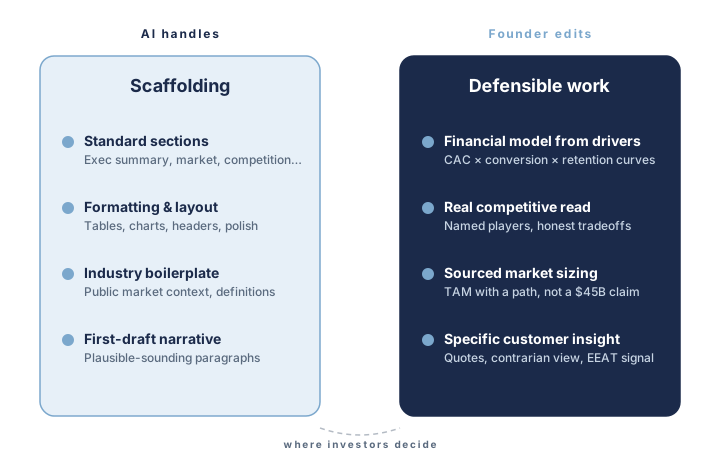
The scaffolding layer is solved. Every tool produced the standard sections in the standard order, with tables, charts, and visual polish that used to require a designer. Industry boilerplate was accurate across the board — LLMs are genuinely good at synthesizing publicly available knowledge.
The defensible layer is not. Four out of five tools produced TAM/SAM/SOM with numbers that looked authoritative but had no sourceable basis ("$45B accounting software market" with no path from a $89/firm/month tool to even 1%). Competitive analysis was either too generic or quietly wrong — ChatGPT named two competitors that don't exist. Financial models grew at suspiciously smooth percentages (the 8x / 4x / 2.5x / 2x year-over-year tell). And hallucinations ranged from obvious (a fake Gartner stat) to subtle (an "average accounting firm has 22 staff" claim I couldn't trace).
The patterns investors flag as "AI slop"
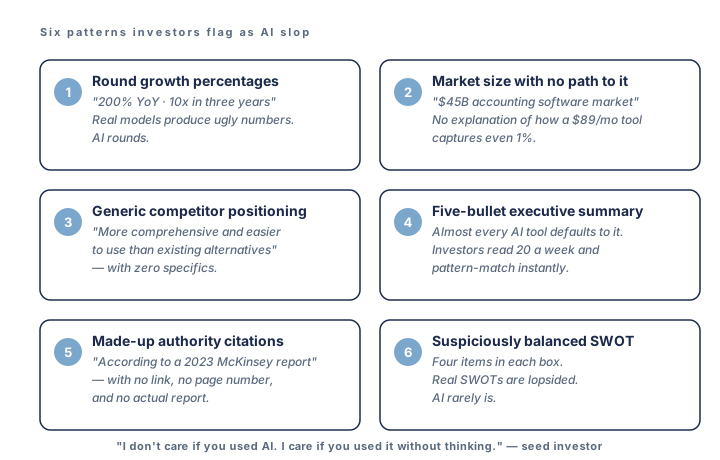
We sent the generated plans to two seed investors. Their flags were remarkably consistent:
- Round growth percentages ("200% YoY," "10x in three years"). Real models produce ugly numbers.
- Market size without a path to it. A $45B TAM claim with no explanation.
- Generic competitor positioning. "More comprehensive and easier to use" with no specifics.
- Five-bullet executive summaries. Investors read 20 of these a week and pattern-match instantly.
- Made-up authority citations ("According to a 2023 McKinsey report" with no link).
- Suspiciously balanced SWOT. Real SWOTs are lopsided.
One investor: "I don't care if you used AI. I care if you used it without thinking. Show me the messy parts you edited."
The manual edit pass
If you're going to use any of these tools, do this pass before you send:
- Replace every TAM/SAM/SOM number with a sourced one. "$X (estimated; based on Y firms × Z revenue)" beats an authoritative-sounding made-up number.
- Rebuild the financial model from drivers. Customers per channel × conversion × ACV × retention. If you can't explain how a number is computed, delete it.
- Name competitors honestly, including the boring ones (incumbents and Excel). Investors will name them if you don't.
- Cut 30% of the length. AI tools default to 30+ pages. Most fundraising decks live in 10–15 pages plus a separate financial-model spreadsheet.
- Add three specific things only you know. Customer quotes, founder insight, a contrarian market view. The EEAT signal that AI can't fake.
- Verify every citation. Click every link.
So which tool should you use?
- Bank or SBA loan: LivePlan. Format matters more than narrative for that audience.
- Internal planning, not fundraising: ChatGPT or Claude with a careful prompt + a free SaaS financial template. Save the money.
- First-time founder who wants guardrails: Upmetrics or Bizway.
- Pre-launch and you also need website, branding, marketing: SoGood, or you're stitching tools together yourself. If you're in this bucket, also read How non-technical founders launch without developers and the AI marketing stack replacing $5k agency retainers.
- Raising from real investors: any of the above for the first draft, then do the manual edit pass. Don't send unedited.
The right framing in 2026 isn't "AI replaces business plan writers." AI replaces the scaffolding — leaving you to do the defensible work, which is what always actually mattered. The tools just make the divide more visible.
Frequently asked questions
Are AI-generated business plans accepted by investors? Investors don't reject plans for being AI-assisted. They reject plans that show the patterns of unedited AI: generic market sizing, formulaic competitor sections, hallucinated statistics, and financial models that don't survive scrutiny. Use AI for the first draft, then replace every made-up number with a sourced one.
What is the most important section of a business plan? For early-stage fundraising, the financial model and the go-to-market plan carry the most weight. Investors skim the executive summary, glance at market sizing, and spend most of their time stress-testing your unit economics and acquisition strategy.
How long should a business plan be in 2026? For a fundraise: 10–15 pages plus a separate financial model. For an SBA loan: 25–40 pages. AI tools default to 30+ pages, which is usually too long for fundraising contexts.