How Non-Technical Founders Launch Companies Without a Dev Team in 2026
Three real paths non-technical founders are using to ship in 2026: AI app builders, no-code + AI assistants, and the AI co-founder route. Honest comparison of cost, time-to-launch, and where each path breaks.
TL;DR. Three viable paths exist in 2026 for non-technical founders: AI app builders (best for SaaS-shaped products that need real software), no-code stacks plus AI assistants (best for marketplaces and CRUD-heavy products), and AI co-founder platforms (best when you also need branding, marketing, and ops, not just the software). None of them remove the need for product judgment or customer conversations — they remove the need for code.
The "I have an idea but I can't code" moment used to end one of three ways: pay a freelancer $20,000 to build a half-finished MVP, find a technical co-founder who'd take 50% equity, or quietly give up. As of 2026, none of those are the default outcomes anymore. The tooling is genuinely good enough that a non-technical founder can ship working software in weeks.
What the tooling has not done is make this trivial. The decision that matters isn't whether to use AI/no-code — it's which path fits your specific product. We're SoGood, an AI co-founder platform — so we have a horse in one race. The first half of this guide is about when to pick a different horse.
What you actually need to ship
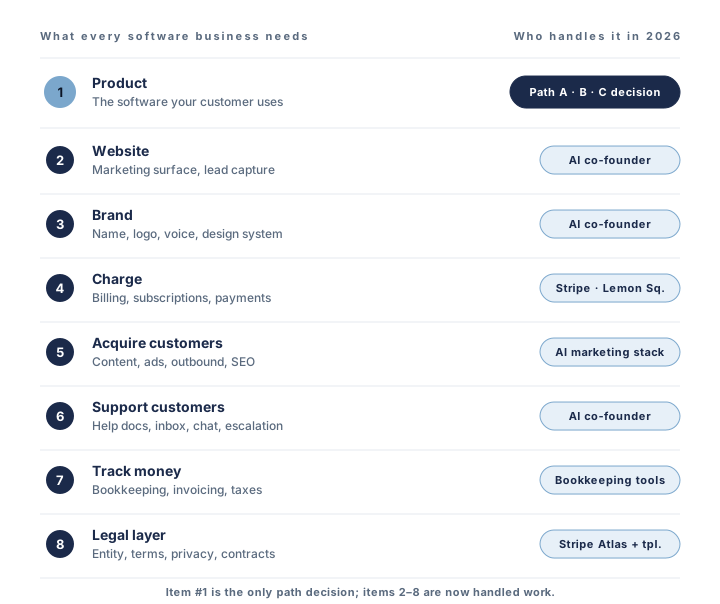
Most non-technical founders mentally collapse "shipping" into "the build" and underestimate the rest:
- A product — the software the customer uses
- A website — the marketing surface that explains and sells it
- A brand — name, logo, voice, design system
- A way to charge — billing, subscriptions, payments
- A way to acquire customers — content, ads, outbound, SEO
- A way to support customers — help docs, inbox, chat
- A way to track money — bookkeeping, invoicing, taxes
- The legal layer — entity, terms, privacy, contracts
Engineering covers item 1 and parts of 2 and 4. The other 5–6 items are non-engineering work that has historically been a mess to assemble. The 2026 difference is that all of items 2–8 can be handled by AI co-founder platforms, no-code tools, or AI assistants. The path-selection question becomes: how do you want to handle item 1?
The three paths
Path A: AI app builders
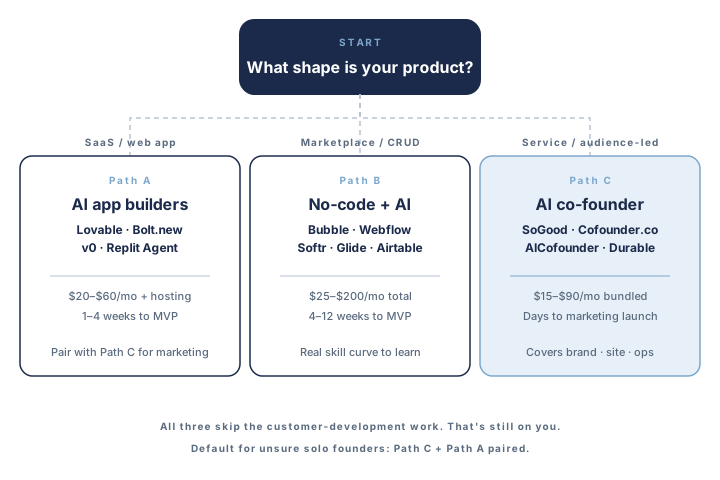
Lovable, Bolt.new, v0.dev, Replit Agent. Describe a product in plain English, get back a working web app — typically React/Next.js with database, auth, and basic styling. Strong on: SaaS-shaped CRUD, marketplaces, internal tools, MVPs. Breaks on: real-time collaborative features, mobile-native apps, complex multi-tenant SaaS, edge cases at scale. Cost: $20–$60/mo per tool plus hosting. Time to MVP: 1–4 weeks of part-time effort. The hidden cost is iteration friction — when you want to change something the AI generated, the cleanest path is sometimes regeneration, which can break adjacent features.
Path B: No-code + AI assistants
Webflow, Bubble, Softr, Glide, Airtable. Mature, boring (mostly a compliment). The 2024–2026 layer of AI assistance has made these easier to start with. Strong on: marketplaces (Bubble + Stripe is solid), internal CRUD apps, marketing sites with custom interactions, membership communities. Breaks on: the 10x scale moment when no-code pricing gets uneconomic, performance-sensitive products, founders who hit modeling limits without engineering instinct. Cost: $25–$200/mo across the stack. Time to MVP: 4–12 weeks. The skill curve is the real cost — Bubble takes 30–80 hours to use well.
Path C: AI co-founder platforms
SoGood, AICofounder, Cofounder.co, Durable. Cover not just the product but the operational shell — branding, website, marketing, lead gen, support, bookkeeping, legal. The product layer is usually limited to marketing sites plus simple business apps; for application code you'd pair with Path A. Strong on: service businesses, content/audience businesses, pre-launch validation, founders consolidating instead of assembling 8 tools. Breaks on: complex software products, founders who already know their preferred tool per function, regulated industries with specific compliance needs. Cost: $15–$90/mo for most, with free tiers on several platforms; SoGood is free at 5 credits/mo, $20 Pro at 20 credits, $90 Expert at 90 credits, plus $10-per-10-credit packs on any plan. Time to marketing-launch: days, not weeks.
How to choose between A, B, and C
Five concrete questions decide it for most founders:
- Does your product require persistent user data, accounts, and a backend? If yes, you're in Path A or B territory; static site builders won't carry you. If no (newsletter, content brand, simple service business), Path C alone may be enough.
- Can you describe the product in plain English without invoking 30 edge cases? If yes, Path A is fast. If your description includes phrases like "depending on the user role" or "if it's the second of the month," you're heading toward Path B's modeling tools.
- How important is design polish on day one? Path A outputs are usually functional but plain. Path B (Webflow, Bubble) gives you finer design control. Path C bundles a brand kit and a styled marketing site by default.
- Will you outgrow it within 12 months? Path A apps are easier to "graduate" off (most generate Next.js or React you can hand to an engineer later). Path B platforms have stickier exits because the data model lives inside the platform.
- How much do you actually want to learn? Path A is "describe and accept." Path B is "learn the tool and own the build." Path C is "delegate the operations layer entirely." Pick the discomfort you can sustain.
If two or more answers point to the same path, you've found yours. If they conflict, default to Path C + Path A paired — covers the operational layer and the product layer with the lowest combined skill floor.
The decision tree
| If your product is... | Pick | And pair with |
|---|---|---|
| Marketing site, newsletter, content brand, simple service | AI co-founder platform | Stripe or Lemon Squeezy for billing |
| SaaS-shaped web app — CRUD, dashboards, basic AI | AI app builder | AI co-founder platform for marketing/ops |
| Marketplace or community | Bubble or Softr | Webflow for the marketing site |
| Internal tool or team app | Glide, Softr, or Retool | Airtable for the data layer |
| Complex multi-tenant SaaS | Freelance engineer ($5k–$25k) | AI co-founder platform for everything else |
| Mobile-first product | FlutterFlow or hire a freelancer | — |
| Regulated-industry product | Engineering team, eventually | — |
What goes wrong
- Building before talking to customers. AI tools make building so cheap that founders skip discovery. Then they ship a product no one wants. First 60 days: 80% conversations, 20% building.
- Confusing tool fluency with business progress. Spending three weeks learning Bubble while the underlying question (does anyone want this?) goes unanswered.
- Refactor paralysis. AI-built code is harder to safely modify than hand-written code. Plan for one full rebuild between MVP and post-PMF.
- Skipping the legal layer. No entity, no terms, no privacy because "we'll do it later." Later is much more expensive. Use Stripe Atlas in the first month.
- Not charging. Free tiers attract users who don't actually want the product. Charge from day one — even $9/month filters the audience to people who'll give you real signal.
The week-one checklist
- Write a 1-page positioning memo. Who, what, what-not, why-different.
- Pick a path. If unsure, default to Path C + Path A paired.
- Set up Stripe or Lemon Squeezy. Charging is non-negotiable.
- Set up an entity ($500 well spent).
- Build the marketing site before the product. Many founders find PMF before the product is built.
- Pick one acquisition channel. Not all four. (See the AI marketing stack guide for what to actually run.)
- Schedule 20 customer interview calls.
If fundraising is part of the picture, also read our honest review of AI business plan generators — what they actually produce vs. what investors reject. Once you start charging, QuickBooks alternatives for startups covers the bookkeeping decision.
Frequently asked questions
Can a non-technical founder build a startup in 2026? Yes. AI app builders, mature no-code platforms, and AI co-founder platforms have collectively made it possible to ship a working software business without engineering hires. The constraint shifts from "can you build it" to "do you understand the customer well enough to know what to build."
What is the fastest way for a non-technical founder to launch a product? Marketing-site-only: AI website builder or AI co-founder, 1–3 days. Basic SaaS or web app: AI app builder, 1–4 weeks for a working MVP. Complex multi-tenant SaaS: 6–12 weeks via no-code or freelance build.
How much does it cost to launch without a dev team? Three ranges in 2026: $0–$200/month using only AI tools and no-code; $2,000–$10,000 one-time for a freelance MVP via Upwork; $20,000–$60,000 for a development agency to build a polished MVP.
What is the biggest mistake non-technical founders make in 2026? Building before talking to customers. AI tools make the build so fast that founders skip discovery, ship something no one wants, and misdiagnose the failure as a product problem.
Do non-technical founders need a technical co-founder eventually? Sometimes — but later than you think, and for narrower reasons than the conventional wisdom suggests. The two real triggers in 2026 are: (1) you're hitting a complexity ceiling that AI/no-code can't cross (custom infrastructure, performance-sensitive features, regulated systems), or (2) you're fundraising at the seed-or-later level and investors are pattern-matching on "needs a CTO." The first is a real product reason. The second is often pattern-matching that's already loosening as more YC and a16z-backed teams launch with AI-built MVPs.
How long does it actually take to launch as a non-technical founder? Surface (brand + marketing site + collecting interest): days. Working MVP for a SaaS-shaped product on Path A: 1–4 weeks. Polished marketplace or workflow product on Path B: 4–12 weeks. First paying customer: weeks 3–8 if you do real customer-development work in week 2; potentially never if you skip it. The launch isn't the bottleneck anymore — the conversations that decide what to launch are.